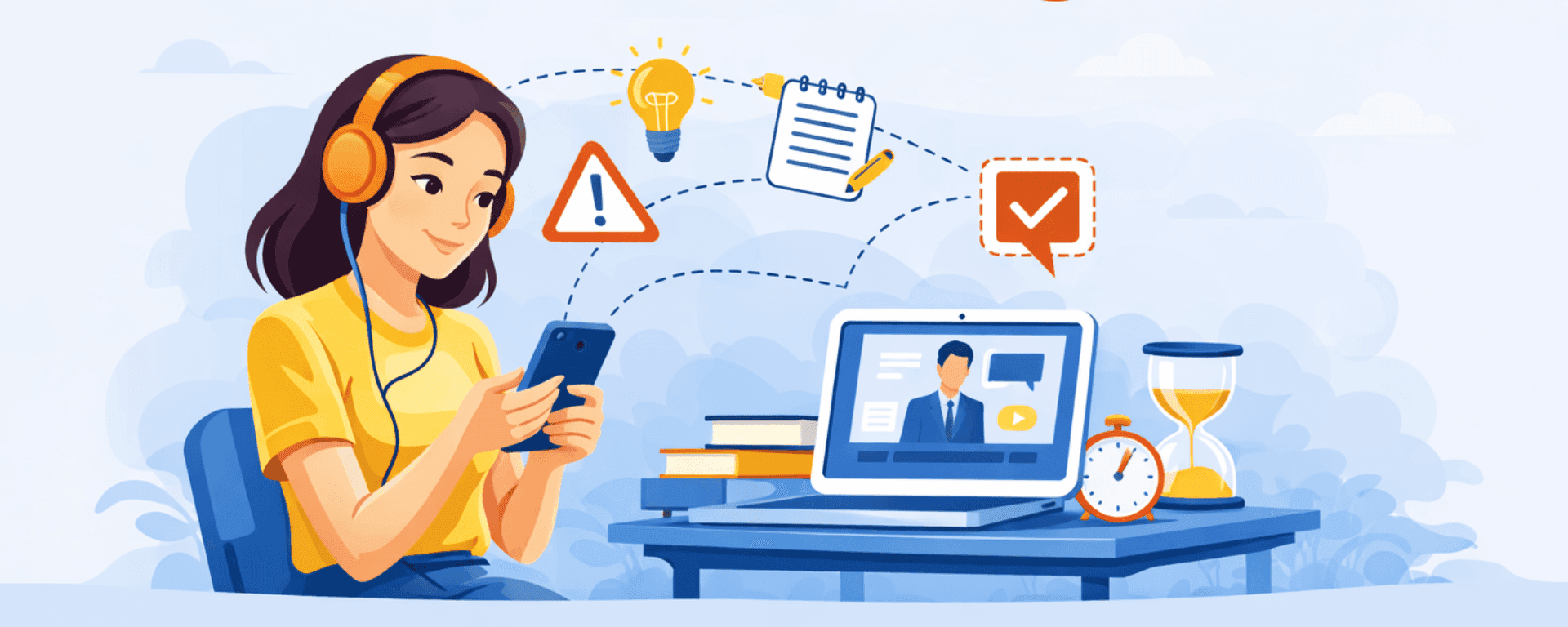
Microlearning: Why Smaller Lessons Often Lead to Better Learning
Discover what microlearning is, why it works, and how research links short, focused lessons with better engagement, lower cognitive load, and stronger retention.
Microlearning: Why Short Lessons Can Improve Learning Outcomes
Microlearning has become one of the most talked-about approaches in digital learning, workplace training, and modern education. The idea is simple: instead of asking people to sit through long, information-heavy lessons, microlearning delivers short, focused learning experiences built around one clear objective at a time.
That sounds modern and convenient, but microlearning is not just popular because it fits busy schedules. It is gaining attention because it aligns with several well-established principles from learning science. When it is designed well, microlearning can reduce overload, make practice easier to repeat, and help learners stay engaged long enough to actually retain what they learn.
Why microlearning works
One reason microlearning works is that people learn better when information is easier to process. Research on cognitive load shows that working memory is limited, and learning becomes harder when too much information is presented at once. Shorter, more focused lessons can reduce that burden and make it easier to understand and remember the material.
Microlearning also works well with two of the most powerful ideas in learning science: retrieval practice and spacing. Retrieval practice means actively recalling information instead of only reviewing it. Spacing means revisiting material over time instead of cramming it into one long session. Microlearning makes both easier to implement because the lessons are short enough to repeat regularly without overwhelming the learner.
What the research says about microlearning
Recent research on microlearning is encouraging. A systematic review published in Heliyon found positive effects across several outcomes, including knowledge acquisition, retention, recall, motivation, engagement, satisfaction, self-efficacy, and transfer when microlearning is designed well and aligned with learners’ needs.
Research in Scientific Reports also found that adaptive microlearning systems can improve learning performance and help learners manage cognitive load more effectively than more conventional microlearning approaches.
The broader science of learning points in the same direction. Research on retrieval practice has shown that actively recalling information leads to stronger learning than passive review, while reviews of spacing and retrieval continue to show that repeated practice over time supports long-term retention. In parallel, major reviews of multimedia learning show that the design of visuals, signaling, segmentation, and other presentation choices can make a meaningful difference in how well people learn.
Taken together, the evidence suggests that microlearning is most effective when it is not treated as “content made shorter,” but as a carefully designed system of focused instruction, practice, and repetition.
The main benefits of microlearning
1. It fits modern attention and busy schedules Many learners do not have time or energy for long study sessions every day. Microlearning makes it easier to study in short bursts, whether that is during a break, on a commute, or between other tasks. That convenience can improve consistency, and consistency is one of the biggest drivers of progress.
2. It reduces cognitive overload When too much information is delivered at once, people are more likely to lose focus or forget what they just learned. Short, focused lessons help learners process one thing at a time.
3. It supports better retention Because microlearning is naturally suited to repeated review, it works especially well with spaced practice and retrieval-based learning. This makes it useful not only for first exposure to a topic, but also for revision and reinforcement.
4. It can improve engagement A lesson that feels achievable is easier to start. A lesson that feels clear and relevant is easier to complete. That is one reason microlearning often performs well in digital environments where drop-off rates can be high.
5. It works especially well with mobile learning Microlearning is a natural fit for smartphones and tablets. Short sessions are easier to complete on mobile devices, which is one reason many learning apps and training platforms have moved toward microlearning-based formats.
Where microlearning works best
Microlearning is especially effective when the goal is to:
- reinforce knowledge over time
- explain one concept at a time
- practice recall through questions or quizzes
- prepare learners for real-world decisions
- refresh prior learning before a test or task
- deliver training in mobile or time-constrained settings
This makes it particularly useful for areas such as theory test preparation, onboarding, safety training, product education, compliance refreshers, language learning, and professional development.
The biggest mistake companies make with microlearning
The biggest mistake is assuming that shorter automatically means better.
A weak microlearning program is often just a long lesson cut into smaller pieces without better structure, practice, or sequencing. That may improve convenience, but it does not guarantee better learning.
- Strong microlearning is built around:
- one clear objective per lesson
- active participation
- repetition over time
- visual clarity
- relevance to real tasks
a clear path from simple understanding to confident performance
How to design better microlearning content
If you want microlearning to work, a few principles matter more than anything else.
Focus on one outcome at a time
Every lesson should answer one clear question: what should the learner be able to know or do after this?
Make the learner respond
Microlearning works best when learners retrieve, decide, apply, or answer instead of only watching or reading.
Repeat content over time
Short lessons become much more powerful when they are revisited at the right intervals.
Use visuals to clarify, not decorate
Illustrations, animation, diagrams, and visual cues should reduce confusion and support understanding.
Build sequences, not fragments
Microlearning works best when small lessons are connected into a larger learning journey.
Why microlearning matters for theory test preparation
Microlearning is especially valuable for theory-based learning because it supports steady progress, repeated practice, and faster feedback. Instead of overwhelming learners with too much information at once, it helps them master one rule, one traffic situation, or one decision at a time.
That is particularly useful in high-stakes learning environments where understanding matters more than memorizing. When learners get short, focused questions, clear explanations, and visual support, they are often better prepared to recall the right answer under pressure.
Final thoughts
Microlearning is not effective because it is trendy. It is effective because it matches how people learn best when they are busy, distracted, and trying to build knowledge over time.
The best microlearning is short, but it is also structured. It is engaging, but it is also evidence-based. Most importantly, it helps learners return often, practice actively, and retain more.
That is why microlearning has become such a powerful format in modern learning design and why it continues to grow in both education and workplace training.
Research sources
- PubMed: Microlearning beyond boundaries: A systematic review and a novel framework for improving learning outcomes
- Heliyon / ScienceDirect: Microlearning beyond boundaries
- Scientific Reports: Optimizing cognitive load and learning adaptability with adaptive microlearning
- Science: Retrieval Practice Produces More Learning than Elaborative Studying with Concept Mapping
- Nature Reviews Psychology: The science of effective learning with spacing and retrieval practice
- Review of Educational Research: Multimedia Design for Learning: An Overview of Reviews With Meta-Meta-Analysis